
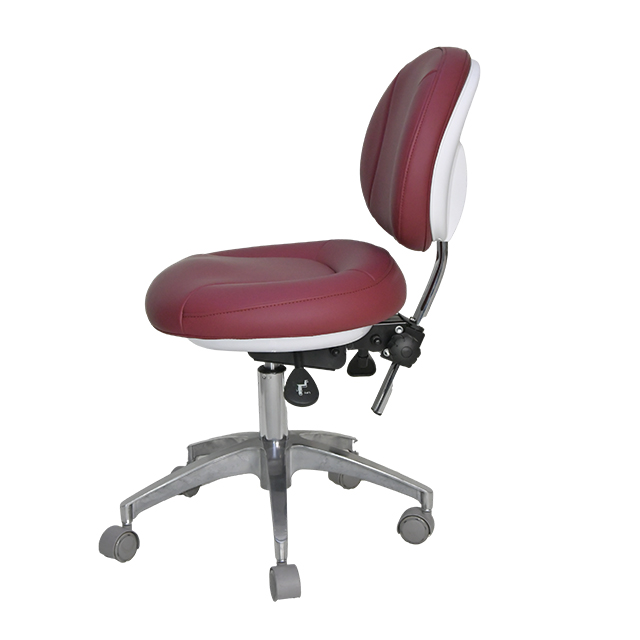
Buying a dentist’s stool is easy if the decision is based only on appearance or price. It becomes more complicated once the stool has to support real clinical work. Operators constantly change their distance from the patient, lean toward the treatment area, reposition their legs, and move around the dental chair. A stool that looks comfortable in a showroom may not work equally well during those movements.
That makes the purchasing question more specific: which features actually deserve attention before selecting a dental operator stool? Height range, seat design, back support, movement, adjustment mechanisms, and floor stability all affect whether the stool fits the operator’s working position. The right choice should therefore be based on how the dentist sits and moves, not simply how much cushioning the product has.
How Dental Stools Support Operator Posture and Workflow
The first question should be where the operator normally works in relation to the patient. A dentist may sit upright for part of a procedure, lean forward for closer access, or shift sideways depending on the treatment area. The stool needs to accommodate those changes without forcing the operator into one fixed posture.
Height adjustment is therefore fundamental. A suitable stool should allow the operator to establish a working height that matches the dental chair and treatment field. Too low a position can encourage excessive forward bending, while excessive height can make the operator work with the shoulders raised or lose stable leg support.
The relationship between the stool and dental chair matters as well. A stool is not an isolated piece of furniture. Its height, seat depth, back support, and base dimensions all influence how easily the dentist can approach the patient and reposition around the chair.
For buyers, this means the first inspection should be practical: sit on the stool, adjust it to a working height, and consider whether the body can approach the treatment area without unnecessary bending or twisting.
Height Adjustment Is Only the First Check
A pneumatic height mechanism may look like a basic specification, but the adjustment system determines how easily the operator can fine-tune the working position. RS-03, for example, uses a pneumatic cylinder with a smooth lifting mechanism, while its base incorporates casters intended for smooth movement across hard flooring.
Other models take adjustment further. RS-05 combines seat-height adjustment with an adjustable foot ring and torso support, giving the operator more ways to establish a stable position. Its design also includes an ergonomic tilt intended to maintain a more natural back curve.
The practical purchasing lesson is that “adjustable” should not be treated as a complete evaluation. Buyers should examine what can be adjusted, how the adjustments interact, and whether those adjustments are useful during treatment.
A stool with many controls is not automatically the better purchase. An adjustment matters only when it solves a real positioning problem. For a clinic with several operators, the value may come from flexible positioning. For a dentist with a consistent working style, fewer but easier-to-use adjustments may be more practical.
The Seat and Backrest Should Match the Way the Dentist Moves
Seat shape becomes more important once the operator’s movement is considered. A completely flat seat provides freedom to shift position, while a shaped seat can provide more defined support. U-shaped designs can create additional space around the thighs and help the operator maintain a closer working position.
RS-05 illustrates this approach with a U-shaped cushion, high-density rebound material, an anatomically shaped back, and ergonomic tilt. The model also provides adjustable torso support that can be positioned for either left- or right-handed operation.
Backrest design deserves equal attention. A backrest should support the operator without preventing the small movements required during treatment. RS-07, for instance, uses a backrest adjustable from 90° to 110° and combines it with adjustable seat depth from 300 to 428 mm.
Those specifications matter because dentists do not all sit in the same position. Seat depth can influence how much support the thighs receive, while backrest angle changes the relationship between the torso and treatment field.
For purchasing teams, the useful comparison is therefore not “Which stool has the softest seat?” It is “Which seat and backrest configuration allows the operator to move naturally while remaining supported?”
A Good Base Should Move Easily Without Feeling Unstable
Mobility is another feature that can be underestimated during purchasing. Dental treatment often requires small changes in position rather than large movements. The stool needs to roll when the operator wants to reposition, but it should not feel unpredictable once the correct working position has been reached.
Caster design plays a direct role. RS-03 uses wear-resistant silent wheels and a five-star aluminum base, with hard-floor casters designed for smooth movement across tile and hardwood flooring.
RS-07 similarly combines a wide aluminum base with silent nylon casters. These details show why the base should be evaluated together with the treatment room’s flooring rather than judged only by appearance.
A wider base, appropriate caster configuration, and smooth rolling characteristics can all affect how the operator moves around the chair. At the same time, excessive rolling resistance can make repositioning inconvenient.
The purchasing check should be simple: sit down, place the feet naturally, move the stool in several directions, and see whether the base follows the intended movement without excessive effort or instability.
Which Dental Operator Stool Configuration Makes Sense?
There is no single configuration that suits every dental practice. The better approach is to match the stool’s adjustment system to the operator’s working habits and the physical layout of the treatment room.
A simpler model such as RS-03 may suit buyers looking for essential height adjustment, pneumatic lifting, durable construction, and smooth movement. Its T-shaped trunk support and aluminum base add specific structural features without turning the stool into an overly complex workstation.
RS-05 takes a more support-oriented approach. Its U-shaped seat, ergonomic tilt, adjustable foot ring, and adjustable torso support make it relevant where the operator wants more control over sitting position.
RS-06 moves further toward individualized positioning, with eight-way control and adjustment, a 5-degree forward tilt, and 360-degree silent casters.
RS-07 offers another combination, including adjustable seat depth, a 90°–110° backrest, a U-shaped ventilation design, and a 20° angled leg-rest design.
These differences illustrate an important purchasing principle: a more sophisticated dental stool is not necessarily the correct choice for every operator. The right model is the one whose adjustments correspond to the movements, posture, and treatment environment of the person using it.
Choose Based on the Work, Not the Specification Sheet
A dental operator stool should be assessed as part of the clinical working position rather than as an ordinary chair. Height determines where the operator sits relative to the patient. Seat shape affects freedom of movement and lower-body support. Backrest and torso support influence how the upper body is positioned. Casters and the base determine how easily the operator can reposition.
That is why a useful purchasing process should involve actual sitting and movement whenever possible. Product specifications can identify available adjustments, but only practical evaluation shows whether those adjustments work together.
Ranging from the RS-03 and RS-05 to the RS-06 and RS-07, Roson’s diverse stool configurations offer varied combinations of mobility features, seat geometries, support levels, and height adjustment mechanisms to suit different operator preferences.
The best dental operator stool is not the one with the longest feature list. It is the one that lets the operator establish a comfortable working position, maintain appropriate support, and move around the treatment area without fighting the stool. For buyers, that makes working posture and actual adjustment needs the most useful starting points for a confident purchase.