
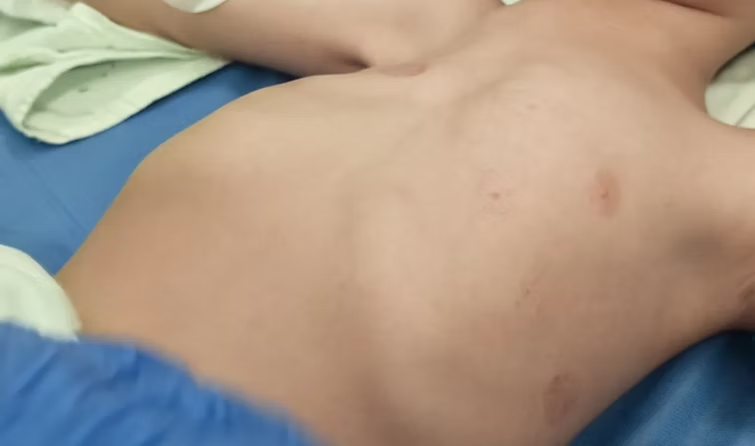
The lesions of Poland syndrome are primarily concentrated in the anterior chest and upper limbs. However, as patients and families research Poland syndrome symptoms, questions often arise regarding whether the condition extends beyond the torso and hands to affect facial symmetry or structure.
Typical Presentation and Rare Associations
In most cases, Poland syndrome does not affect the face. The condition is typically unilateral and mainly involves the chest wall, with or without ipsilateral upper limb abnormalities. Chest wall involvement may affect both bony and soft tissues. Bony structural abnormalities primarily manifest as absence, thinning, deformation, or fusion of the ribs and costal cartilages, which can lead to chest wall depression or chest wall defects.
Soft-tissue abnormalities commonly include underdevelopment or absence of the pectoralis major and minor muscles and, in females, breast tissue asymmetry that becomes more apparent after puberty. Upper limb involvement, when present, usually affects the distal hand and may manifest as syndactyly, brachydactyly, or other skeletal anomalies. Additionally, patients may also develop scoliosis.
Rarely, Poland syndrome may coexist with other congenital conditions, such as Moebius syndrome. Current evidence suggests that these associations reflect shared developmental or vascular factors rather than a direct causal relationship, and Poland syndrome itself does not directly cause facial paralysis or primary neurological impairment.
Correcting the Chest Wall Deformities at ICWS
While the face is generally spared, the asymmetry of the chest can be profound. Specialized centers such as the Institute of Chest Wall Surgery (ICWS) focus on correcting the deformity and reconstructing the tissues through a personalized surgical plan to restore the appearance and integrity of the chest wall.
For patients with skeletal depression of the chest wall, correction may be achieved using the Wang procedure, which is designed to lift and stabilize the depressed bony framework. In cases involving structural defects, chest wall reconstruction may be performed using autologous bone or artificial materials (such as the MatrixRIB bar), while soft tissue defects can be addressed through muscle flap transplantation, autologous fat grafting, or prosthetic implants.
Overall, these methods aim to restore chest wall symmetry in a clinically appropriate manner, improve thoracic stability, and provide adequate protection for vulnerable organs.
Tailoring Your Treatment Plan
Understanding the diagnosis and its potential impacts is the first step toward a successful recovery. If you are concerned about the physical asymmetries or skeletal deficiencies accompanied by this condition, a consultation with The Institute of Chest Wall Surgery (ICWS) can provide clarity. By focusing on advanced reconstructive surgery, the institute helps patients achieve a more balanced appearance and improved quality of life through individualized care.