
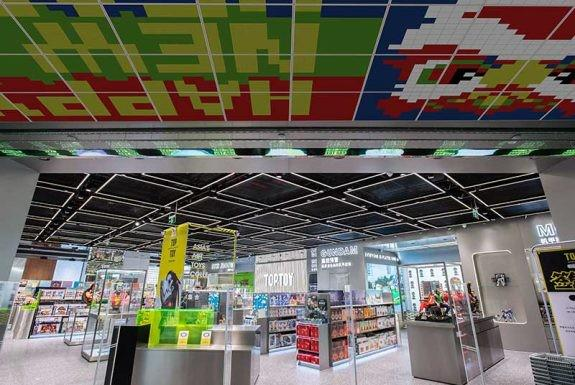
E Ink prisms are modular e-paper elements that allow a wall to display changing color patterns without behaving like a conventional glowing screen. A practical e ink wall display is therefore not only a screen fixed to a wall. It is closer to a system of tiles, installation structure, control software, and content planning.
This distinction matters because prism walls are used in physical spaces where viewing comfort, power use, and visual integration are as important as motion or brightness. Its form is based on tiled units rather than a single rectangular panel, so designers can create surfaces that feel more connected to the building environment.
An e-ink prism wall can cover selected zones, guide attention, or support a branded interior without using constant backlight. Each tile becomes part of a larger visual field. Because the system is modular, it can be adapted to different wall dimensions, entrance areas, exhibition corners, or meeting spaces.
This makes it suitable for locations where a fixed printed mural would be too static, but a bright digital display would feel visually heavy. A prism system also supports repeated visual updates. A lobby might show a calm pattern during office hours and a more expressive graphic during an event.
Modular Surfaces and Reflective Color
Unlike posters that require replacement, the visual surface can change through digital control while remaining physically installed in the same place. From a planning perspective, the value of an e ink wall display comes from blending information and decoration. It can present visual themes, simple messages, or environmental patterns while keeping a paper-like appearance.
The wall becomes a reusable communication layer rather than a one-time design material. This modular logic also helps with maintenance planning. When a wall is built from repeated display elements, teams can think about content zones, update schedules, and visual rhythm separately from the building surface itself.
An e-ink prism wall is most appropriate when slow, deliberate visual change is more useful than continuous animation. E-paper technology is also known for image retention. Once an image is displayed, it can remain visible with limited power demand until the next update.
This property is important for interior surfaces because walls are often viewed for long periods, and unnecessary energy use can become a concern in large installations. The paper-like surface can reduce glare compared with luminous screens. In reception spaces, galleries, offices, or retail settings, a calmer display surface may be easier to combine with lighting, furniture, and signage.
How Content Is Updated and Used
It gives designers another option between static decoration and conventional digital signage. A full-color e ink wall display is especially relevant when the visual goal involves atmosphere. Color patterns, soft gradients, and slow changes can support the identity of a room without asking viewers to focus on rapidly moving content.
That restrained behavior is one reason e-paper works well on architectural surfaces. A prism wall must work as a managed system, not only as a collection of panels. An e-ink prism wall can therefore support seasonal decoration, event branding, and periodic information updates. This is useful in places that need both visual consistency and flexibility.
A corporate office may want a quiet entrance display most days, while a showroom may need to change visual themes for product launches. The same installed surface can serve multiple purposes through planned content updates. Interior integration also depends on scale, viewing distance, and installation quality. Because e-paper is reflective, the result is affected by surrounding light.
A designer should consider where viewers stand, how daylight enters the room, and whether the content should be read as information or viewed as ambience. In this sense, an e ink wall display works well when it is treated as part of the room design.
Modular E-Paper Wall Systems Integrating Digital Art and Architectural Design
Modular splicable e-ink prism walls serve as unique architectural decorative displays that replace static murals and glaring luminous screens. Specializing in architectural integrated e-paper solutions, SEEKINK independently develops exclusive full-color e-paper film and synchronized control systems. They provides flexible scalable wall display schemes, perfectly merging digital visual art with interior design and setting new benchmarks for space decorative hardware.